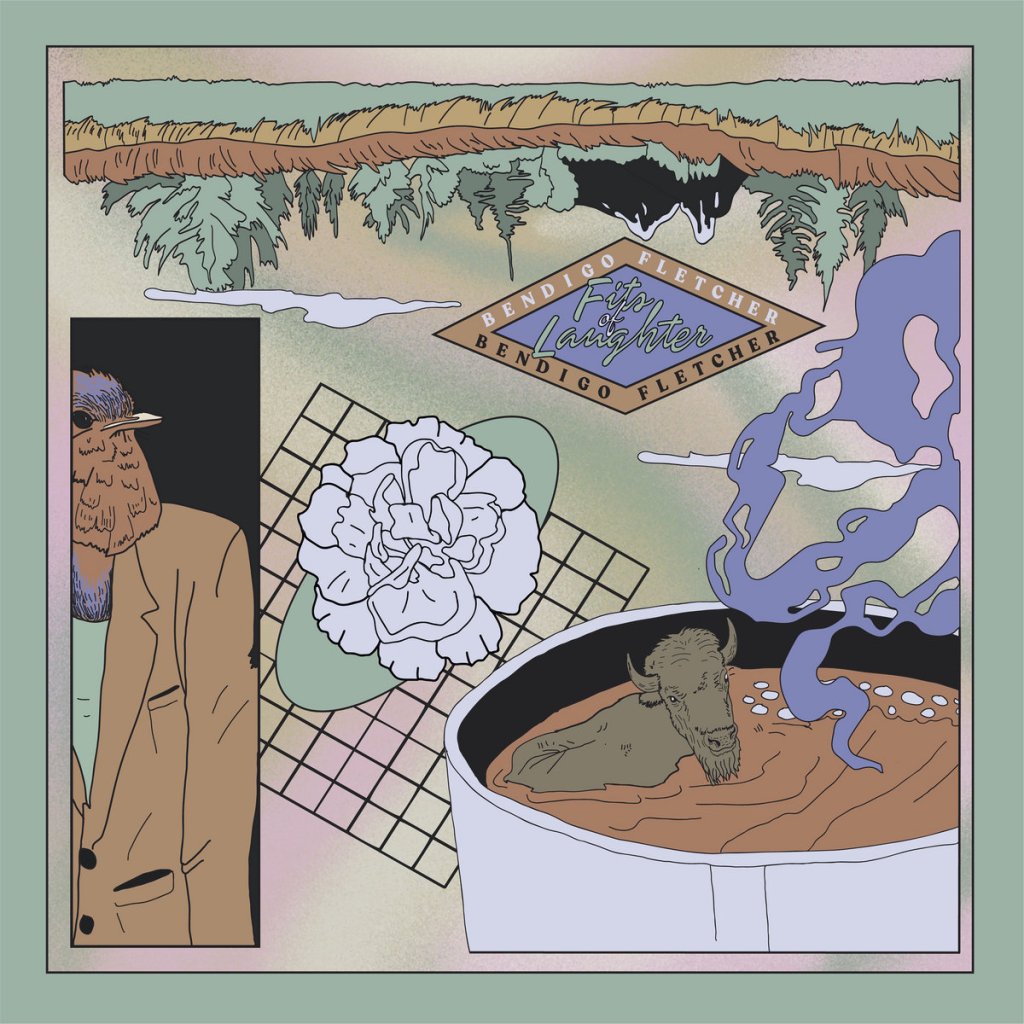
Bendigo Fletcher, Elektra, 2021
“People think HE’S Bendigo!” Bendigo Fletcher’s Evan Wagner, keyboard, excitedly tells me, pointing to the band’s lead vocalist and chief lyricist, Ryan Anderson. Ryan bucks his teeth and flashes a toothy smile our way at the sound of his name. On the back of their debut album Fits of Laughter, the Kentucky five-some find themselves at the Troubadour in Los Angeles, opening for an Anderson East tour in late October of 2021.
And while it doesn’t pop up until a few songs into their set, the album’s opener “Sugar in the Creek” turns heads almost immediately with its raucous drumming from Chris Weis, delicately draped over perfunctory, though only in appearance, finger plucking. The story therein is a teary-eyed and wholly fitting introduction to the eight track LP, Bendigo’s sound, and the naturalistic awe the group cannot help but precipitate. As soon as you’re used to the gently rocking sway of the folksy road trip tune, the group takes a psychedelic turn into the unknown, placing man and melody simultaneously against and in harmony with one another. All the while, the group elucidates and ponders over whether an indulgence of living on and off the land away from one’s past is doable, worth it, or even consequential compared to the power of a thunderstorm. By the time they’ve ramped up to a triumphant final victory lap, Ryan’s howling seems only right, and still drops jaws farther than he forces his own mandibles apart.
But part of this octad is indeed the narrative itself. The aforementioned sugary listener is replaced out of time with a lost love, as Ryan’s speaker struggles to make sense of a failed relationship both through and as a bird himself in “Birding.” His pain over the one who “took a wing from the bird of our feather,” is conflated by the admission that “Well I miss you up on the wire.” While being literarily rhizomatic and interconnected in theme, the vocal delivery of Ryan’s crooning is off-kilter. Consistently and decidedly adjacent from the instrumentals we are privy to amongst the delicately building auditory motifs. Connor Powell on bass shines here, with ease setting a seismic groove that shrouds the track in a lush warm daydream, further elucidated by a shimmery electric riff that rises pleasingly. There exists a definitively precise balance of spacing between the mouthpiece and his fellow musicians that allows the group to get the seeming most from their unusual sound, which Ryan rightfully notes as “bucking” any genre confines of folk, country rock, or alternative.
What Fits of Laughter primarily does though is remain transitory, in that it never overstays its welcome in the new auditory forest it happens to find itself in. Bendigo is committed to a surprise factor via delighting of the mind and senses, reminding you of reasons to breathe deeply and live freely. Often our (needed) guide, Ryan, looks back on time with a way that gives him meaning through its passing. The moments in of themselves in “Donkey Boy Blues” do not exist in any particular time sphere, yet they capture us as humans as both young and deeply older beings. At times, it may appear that Ryan et al. are smirking on their lyrically delayed puns, almost inviting you to guess where the line won’t go. These moments are elaborate, silly, heartfelt, and pointless all at once. Committed to an idea of finding meaning in tragedy, Bendigo lays before us an honest admittance of ignorance both socially and spatially. An introduction to a group of people is expanded from one small moment into an exploration of humanity and outer space itself. While cosmically focused in context and concept, it appears we are witnessing an interpretation of anxiety that is beautiful and depilating simultaneously. And at the end of it all, the group reminds us that it’s okay, “that being human being ain’t so bad.”
For Bendigo Fletcher though, this exploring of life cannot stop. Once the internal self has even been a little bit resolved or abstracted meaningfully from, the group divulges into examining ourselves then in relation to others. The album examines an interconnected scene where everything is equally separate as it is connected. There is a part of us that relates joy to hysteria by inevitably bridging outbursts of manic depression to “fits” of pure laughter. This unity to Bendigo is examined audibly and in terms of thematic connectivity, giving way to a spectacular revelation of both. “Buffalo Rodeo” builds throughout its eerie and shiny duration to a epiphanic crescendo, pairing Ryan’s howls with blissful exuberance in the possibilities of life. “What more could you want in your lifetime?” they ask, seemingly emotionally out of breath, smiles across all their faces at the close of this one, sent off gently by Andrew Shupert and Ryan’s guitars.
And it’s worth dividing this album into distinct halves, if only for our sake as consumers. While the next two songs were leading singles respectively for the album in the summer prior, their place here is welcome, as both songs contain multitudes of journeys by the time they’ve surprisingly ended. “Evergreen” is downright rambunctious, placing a thumping sensibility and tone that is reverberated throughout by the fiery folk-rock feel that cascades off their airy plumes of whimsicalities considered. It’s a total turn for a band that doesn’t typically get this in your face, clashing with their convention and vocal limitations as Ryan screams somehow audibly for us over clanging riffs. The band almost as immediately pulls right away, sending us off on another journey of psychedelic paranoia that is only elicited by feeling due to the contrasting calming lull that sways in its distortions otherwise. The also dissociative “Astro Pup” makes good use of a what feels like an auditory epigraph, or a framing for the song as a whole, as it then evolves into another folk revitalization of sound and technique. The song, written about a time in Ryan’s life of couch-surfing, examines a relationship retroactively and in a postmodern appraisal, wanting to move past it by fully working through it. Honest and striking, the track live excites without the studio-engineered diluted and warped ending, as strangely uplifting as that rendition is.
The penultimate track “Retail Lord” may be Bendigo’s crowning achievement on the album however, as the daydream of the speaker and his lover is refracted from a precious tender moment then out to the expansive wonders of the natural universe. It’s almost as if this youthful love for Ryan’s speaker has allowed him to grow more fully into himself, an integral part of his ability to see how nature is trying to tell us all something. “The colors of the world that go together best / are the deep evergreens and the reds of the robins breast” The natural rhythm and flow of the line are inevitable, the words traipse easily from one to the next, basking in the joy of their shared reality. “Retail Lord” is wonderfully bizarre sonically, encapsulated by a persistent though not overpowering auditory wobbling that permeates the song’s choruses. It’s a delightful piece, and a defining moment for the group.
Perhaps we don’t know how to make sense of our journeys, or when and how they end. Perhaps our journeys are not just our own, but rather the culmination of a larger trek, started by some distanced ancestor long ago. As the album draws to a close, Bendigo seem intent on keeping the momentum of the party alive, but ultimately acknowledging that it’s time for us all to move forward by looking backward. To get back to the roots from which we are inextricably linked, in order to make sense of where we then can possibly go in formation of new ones. In “Ulterior Motives” we go from downtrodden to upbeat to pensive, stopping everywhere in between. Seemingly, these “in between” spaces are what interest Ryan and through him Bendigo the most. That these subterfuges of reality exist for us not only because we experience them ourselves, but that they are steeped in the interrelated way of things, such that we make sense of them by proclaiming them to others. As they remind us in their sendoff, “Call your mother, call your mother…”


One response to “Album Review: Fits of Laughter”
Woah
LikeLike